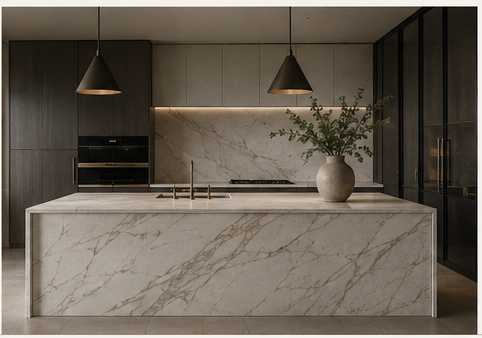
Edge Profiles
Edge profiles: the last decision you’ll make, and the one you’ll touch every day.
Edge profile is usually settled in five minutes at the end of a long selection process. It is also the part of the counter your hands are on constantly. Here is what each one actually does.
The Basics
What an edge profile is.
An edge profile is the shape machined into the exposed front edge of a countertop after the slab is cut to size. Every counter has one, including the plainest, because a raw sawn edge is sharp and fragile and would chip the first time something knocked it.
The choice affects three things people rarely think about until they are living with it: how the counter feels against your forearms while you work, how easy it is to wipe crumbs off into your hand, and how well the edge survives being hit. Looks are the fourth thing, and usually the only one discussed in the showroom.
The Profiles
The ones people actually choose.
There are dozens of named profiles in the trade. In practice, nearly every kitchen we fabricate uses one of these.
A square edge with the sharpness taken off. The default, and the most common choice by a wide margin. Reads modern, costs the least, and is the easiest to keep clean because there is nothing for anything to sit in.
A flat angled cut across the top corner, usually a quarter inch. Slightly more formal than eased without being decorative. Handles knocks well because the impact point is a broad flat rather than a corner.
The top corner rounded away, the bottom left square. Soft against the body, sheds water, and forgiving of contact — the profile we most often suggest when there are young children in the house.
The entire edge rounded into a half-circle. The softest option and the most forgiving of impact, though it visually thins the counter, which works against you if you chose a thick slab for presence.
An S-curve, and the traditional choice for formal kitchens. It is the most decorative profile we cut and the one that most defines a room’s period. It also has a groove, which matters — see below.
Two pieces joined at a folded corner so the counter reads far thicker than the slab actually is. This is how a two-centimetre slab ends up looking like a six-centimetre one, and it is the profile behind most of the chunky modern counters people photograph.
The Trade-offs
What nobody mentions in the showroom.
Decorative profiles collect crumbs. An ogee has a groove running the length of the counter, and that groove catches flour, crumbs and wiped-off spills. It is beautiful and it is more work every single day. If nobody has said that to you before you choose it, they have not been straight with you.
Square-ish edges chip at corners. Eased and bevelled edges are fine along a run, but the outside corner of an island or a peninsula takes the impact of everything that gets carried past it. Rounding that one corner while keeping the profile elsewhere is a normal request and we do it routinely.
Rounded profiles make stone look thinner. A full bullnose removes visible thickness from the edge you are looking at. On a thin slab that can leave the counter looking slighter than you expected.
A complex profile costs more because it costs time. Machining an ogee means more passes, more tooling and more hand finishing than easing an edge. The material is the same; the labour is not.
The material limits the options. Porcelain comes in thin profiles and is more brittle at the edge, so it favours mitred and eased treatments over deeply carved ones. Softer stones like soapstone take a decorative profile beautifully. We will tell you at templating if a profile fights the slab you chose.
A waterfall runs the stone down the side of an island to the floor. It is a design feature that happens to involve the edge, not a shape machined into it.
Done properly, the pattern continues around the corner and down the leg as if the stone were folded. That requires cutting both pieces from the same slab in the right sequence, which has to be decided before anything is cut.
The vertical panels are full-height pieces of slab. Budget for the extra material, not just the extra labour.
Tell us at consultation rather than at templating. By templating, the slab may already be committed.
Questions
Frequently asked.
More on our FAQ page, or bring the question to a showroom where you can run your hand along the samples.
What is the most popular countertop edge profile?
The eased edge, and not by a small margin. It suits contemporary and transitional kitchens, costs the least to machine, and is the easiest edge to keep clean. Half bullnose is the usual second choice, particularly in households with young children, because a rounded top edge is kinder on impact.
Does the edge profile affect the price?
Yes, though through labour rather than material. An eased edge is a single pass; an ogee needs multiple passes, specialised tooling and hand finishing. Mitred edges cost more again because they involve joining two pieces and aligning the pattern across the seam. We quote the profile with the job so there are no surprises.
Which edge profile is best with kids?
Half bullnose or full bullnose. Both remove the hard top corner at exactly head height for a small child, and both are more forgiving when something is swung into them. If you prefer the look of a square edge, a common compromise is to keep it throughout and round only the exposed corner of the island.
Can I have a thick-looking counter without buying a thick slab?
Yes — that is exactly what a mitred edge does. Two pieces are cut at forty-five degrees and joined so the edge folds down, giving the appearance of a much thicker slab while using standard material. Most of the substantial-looking modern counters you have seen are built this way.
When do I have to decide on the edge?
At templating, which is comfortably late in the process — after the slab is chosen and the layout is confirmed. The exception is a waterfall, which affects how the slab is cut and needs deciding at consultation.
Can I use different profiles in the same kitchen?
You can, and occasionally it is the right answer — a softer profile on an island where people gather, a simpler one on perimeter runs. It is worth being deliberate about it rather than accidental, because mixed profiles read as a mistake unless there is a visible reason for the change.
Granite Dynasty
Run your hand along it first.
Edge profiles are impossible to judge from a drawing and obvious in about two seconds in person. We keep samples of each at all three showrooms — Winnipeg, Brandon and Winkler.
Or call 204 791 1999 — Monday to Friday.