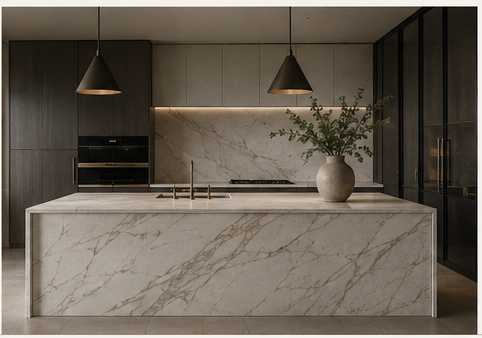
Porcelain · Winnipeg, Brandon & Winkler
Porcelain countertops you can set a hot pan straight down on.
Porcelain is fired, not bound with resin, so heat and sunlight do not touch it. We carry the LX porcelain line exclusively in Manitoba, and we keep it in stock.
The Material
Porcelain on its own terms.
Porcelain countertops are clay and mineral powders pressed under enormous pressure and fired at temperatures well above what any kitchen will ever produce. That single fact explains most of the material’s behaviour. There is no resin binder in it, which is what makes quartz heat-sensitive, and no natural porosity, which is what makes granite and marble ask for sealing. A porcelain slab has already survived hotter than your oven gets.
It is also the newest surface on our floor and the least understood. Most people arrive asking about quartz and leave asking about porcelain, usually after we explain what it does with a pan lifted straight off the burner.
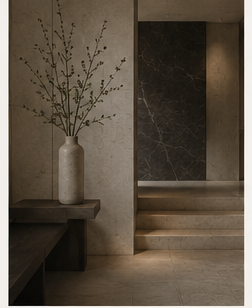
Exclusive to Granite Dynasty
LX porcelain, and nowhere else in Manitoba.
Our porcelain comes from LX, and we are the only fabricator in Manitoba carrying the line. That is not a marketing arrangement. It means the LX slabs on our showroom floor are not something you can photograph here and price against a shop across town, because no other shop in the province has them.
It also means we stock it rather than order it in. Porcelain is a special-order material at most fabricators, which adds weeks to a project and removes the one thing that matters most when you are choosing a surface: standing in front of the actual slab. The same manufacturer supplies our LX quartz, so if you are weighing the two, you can see both lines side by side in one visit.
The Comparison
Porcelain vs. quartz.
These are the two engineered surfaces, and they fail in opposite directions. Quartz is the better all-rounder for a standard indoor kitchen. Porcelain wins wherever heat, sunlight or a very thin profile are part of the problem.
Porcelain
Quartz
If your kitchen is a normal indoor kitchen and you are content to use a trivet, quartz is probably the more practical choice and we will tell you so. Porcelain earns its place when the surface is going somewhere quartz struggles.
Where It Excels
Where porcelain is the right answer.
Four situations come up repeatedly, and in all four porcelain is not merely acceptable but genuinely better than the alternatives.
Manitoba puts a surface through a 60-degree annual swing and five months of salt and sun. Porcelain does not fade, does not absorb moisture, and does not care about a freeze-thaw cycle.
If pans come off the burner and onto the counter, porcelain removes the failure mode entirely rather than managing it.
A material rated for direct heat, used where heat is the whole point. See our fireplace surrounds.
The thin profile makes a waterfall look like a folded sheet rather than a stacked block.
Care
Maintenance, such as it is.
Soap and water. That is the entire routine. Porcelain is non-porous, so nothing soaks in and there is no sealer to reapply, ever — unlike granite and marble, which want resealing on a schedule.
Visit a showroom and choose from stock. With porcelain this matters more than with quartz, because the pattern is printed to the slab rather than repeated through it.
We template the actual space. Porcelain is unforgiving of a bad measurement in a way softer materials are not.
Porcelain needs specialist blades, slower feed rates and careful support through the cut. Shops without the tooling for it sub the work out. We do it at our own facility in the RM of Springfield, on the eastern side of Winnipeg.
Because the work never leaves the building, a five-day turnaround is realistic within roughly 150 km of Winnipeg. Farther out we still fabricate and install — we quote a real date rather than a default one.
Can you put a hot pan directly on porcelain?
Yes. Porcelain is fired at temperatures far beyond anything a kitchen produces, and it contains no resin binder to scorch. A pan lifted straight off the element will not mark it. This is the single clearest difference between porcelain and quartz, and it is the reason most people who choose porcelain choose it.
What are the downsides of porcelain countertops?
Three, honestly. The edges are more brittle than quartz or granite, so a hard strike on a corner can chip it. The colour range is narrower, because the pattern is applied to the slab rather than running through the body of it, which also means a deep chip can expose a different colour underneath. And it takes specialist tooling to cut, so not every fabricator will quote it — and those who sub it out add time and cost.
Is porcelain better than quartz?
For a normal indoor kitchen where trivets get used, quartz is usually the more practical surface and has far more colours. Porcelain is better wherever heat, sunlight or a thin profile matter — outdoor kitchens, serious cooking, fireplace surrounds, waterfall edges. Neither is the better material in the abstract. They are better at different jobs.
Does porcelain need to be sealed?
No, and it never will. It is non-porous, so there is nothing for a sealer to do. Granite and marble need resealing periodically; porcelain and quartz do not.
Can porcelain be used outdoors in Manitoba?
Yes, and it is one of the few surfaces that genuinely can. It is UV stable, so it holds its colour in direct sun rather than fading the way some quartz does, and being non-porous it does not absorb moisture that would otherwise freeze and expand. An outdoor kitchen here has to survive roughly a 60-degree annual temperature swing, and porcelain handles it.
Where can I see LX porcelain in Winnipeg?
At our showrooms. We are the only fabricator in Manitoba carrying the LX line, and we hold it in stock rather than ordering it in, so you can see the actual slabs at our Winnipeg-area, Brandon or Winkler locations. Hours and addresses are on the showrooms page.
Granite Dynasty
Fired. Stocked. Ours alone.
The only LX porcelain in Manitoba, held in stock and cut in our own shop. Come and put your hand on a slab before you decide.
Or call 204 791 1999 — Monday to Friday.