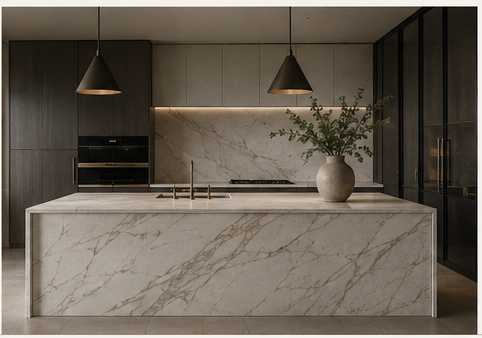
Natural Stone
Natural stone countertops: quarried, not designed.
Granite, marble, quartzite and soapstone are quarried, not manufactured. Nobody chose the pattern. We source them slab by slab so you pick the actual piece going into your kitchen.
The Short Answer
What natural stone means, and what it costs you.
Natural stone countertops are cut from quarried rock rather than engineered from crushed mineral and resin. Granite, marble, quartzite and soapstone are the four we fabricate. Each slab is a one-off, which is the entire appeal and also the source of every practical difference between natural stone and quartz.
The trade is straightforward. You get a surface that cannot be reproduced and that no showroom sample can honestly represent. In exchange, natural stone is porous to varying degrees, needs sealing, and has to be sourced before your project can be scheduled — we do not hold it in stock the way we hold quartz and porcelain.
That sourcing step is the one that catches people. A quartz kitchen can be templated the week you decide. A quartzite kitchen starts when the slab you chose is standing in the shop.
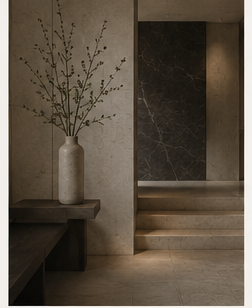
The Four Stones
Which one belongs in your kitchen.
They behave very differently. The honest version of each, including where it is the wrong answer.
The hardest-wearing of the four and the most forgiving of a busy kitchen. Igneous rock, so the pattern is speckled and granular rather than veined. Takes heat, resists scratching, and asks only for periodic sealing. Choose it when you want natural stone and you cook a lot.
The most beautiful and the least forgiving. It etches — lemon juice, wine and vinegar dull the polish chemically, which no sealer prevents. People who love marble accept that and enjoy the patina. People who want a counter that stays exactly as delivered should not buy it, and we will tell you so.
Harder than granite, and often mistaken for marble because the good ones are dramatically veined. Metamorphic sandstone, so it has the durability that marble lacks and the drama that granite lacks. It is also the one most often mislabelled in the trade — plenty of “quartzite” on the market is soft dolomitic marble.
Soft underfoot of a knife and completely immune to acid, which makes it the opposite trade from marble: it scratches but it never etches. Takes a hot pan straight off the burner. Darkens over time into a patina that owners either love or repeatedly try to sand out.
Choosing
A decision rule that fits on one line.
If the counter has to survive teenagers, buy granite. It is the most durable of the four and the least demanding day to day.
If you want the veining and you cook seriously, buy quartzite. It gives you marble’s drama with granite’s hardness, at the price of a longer search for the right slab.
If you bake and you hate sealing, buy soapstone. Nothing acidic touches it, hot trays go straight down, and the scratches become part of it.
If you want marble, buy marble — knowingly. It is the correct answer for a baking counter or a butler’s pantry, and a hard one for a family kitchen island.
And if the honest answer is that you want the look without the maintenance conversation, that is quartz, and we would rather point you there than sell you a slab you will resent. It is nine of every ten kitchens we build for a reason.
Colour, movement, how dramatic. That narrows four stones and several hundred names down to something searchable.
Natural stone is not stocked here the way quartz is. We source against what you described, which is why this step takes days rather than minutes.
Not a chip. A four-inch sample of a veined stone tells you almost nothing — the pattern is the point, and it operates at slab scale.
Where the veining lands on your island is a decision, and on a book-matched or waterfall layout it has to be made before anything is cut.
Sealing
What sealing does, and the two things it doesn’t.
Sealing fills the microscopic pores in natural stone so liquids sit on the surface long enough to be wiped rather than soaking in and staining. It is quick, you can do it yourself, and how often depends on the stone and how hard the counter works — granite less often, marble more.
Two things a sealer will not do. It will not stop marble etching, because etching is an acid reaction with the calcium carbonate in the stone itself, not a stain sitting in a pore. And it will not repair damage already done. Sealer is prevention, applied to a clean dry counter.
The water test settles when to reseal: drip water on the counter, wait fifteen minutes, and see whether it beads or darkens the stone. Darkening means it is due. Care and maintenance covers the routine for each material.
Quartz and porcelain never need any of this. That is the trade you are making, in both directions.
Fabrication
Cut in Winnipeg, by the crew that installs it.
Every natural stone slab we sell is templated, cut, edged and polished at our own facility in Sunnyside, in the RM of Springfield inside the Perimeter. Nothing is subcontracted, which matters more with natural stone than with anything else we handle.
It matters because natural stone does not tolerate being treated as a product. Veining has to be read before it is cut, a fissure has to be recognised as natural rather than reported as a crack, and a book-matched pair has to be sequenced correctly the first time because there is no second identical slab. A shop cutting to a work order it did not write cannot make those calls.
See countertop installation for the full sequence, or countertop replacement if there is an existing top to come out first.
What is the difference between natural stone and quartz?
Natural stone is quarried rock, cut and polished. Quartz is engineered — crushed mineral bound with resin and pigment in a factory. The practical consequences: natural stone is unique per slab, porous, and needs sealing; quartz is consistent, non-porous, and never needs sealing. Neither is better. They suit different people.
Which natural stone is the most durable?
Quartzite, marginally ahead of granite on hardness, though granite is the more forgiving of the two in a working kitchen because it hides wear better. Marble is the softest and the most reactive. Soapstone is soft but chemically inert, so it scratches and never etches.
How often does natural stone need sealing?
It depends on the stone and the traffic rather than a calendar. Granite typically goes longest between coats, marble the shortest. Use the water test: drip water on the surface, wait fifteen minutes, and reseal if the stone darkens rather than beading.
Can I see the actual slab before you cut it?
Yes, and with natural stone you should. Sample chips are close to useless for veined material because the pattern operates at slab scale. We will not cut a natural stone slab you have not seen at full size.
Why does natural stone take longer than quartz?
We stock quartz and porcelain; natural stone is sourced per project. The sourcing happens before templating, so the extra time lands at the front of the schedule rather than the back. Once the slab is in the shop, fabrication and installation run on the same timeline as anything else.
Is a fissure in my slab a crack?
Almost always no. A fissure is a natural separation formed as the rock did, and it is a normal characteristic of granite and quartzite rather than a defect. A crack is a break across the structure. We will point out fissures at slab selection so nothing is a surprise once it is installed.
Why Granite Dynasty
What sets our countertops apart in Manitoba.
Cut in our own shop
Every countertop is templated, cut and finished at our facility in the RM of Springfield. Nothing is sent out to a subcontractor.
LX, only here in Manitoba
We are the only fabricator in Manitoba carrying LX quartz and porcelain, alongside Cambria and HanStone quartz.
Stock you can see
Quartz and porcelain are kept in stock, and within 150 km of Winnipeg most jobs go from templating to install in about five days.
BBB Accredited, A+
Granite Dynasty Inc. is a BBB Accredited Business with an A+ rating, with showrooms in Winnipeg, Brandon and Winkler.
Granite Dynasty
Come and stand in front of the actual slab.
Natural stone is the one material a website genuinely cannot show you. Winnipeg, Brandon and Winkler.
Or call 204 791 1999 — Monday to Friday.