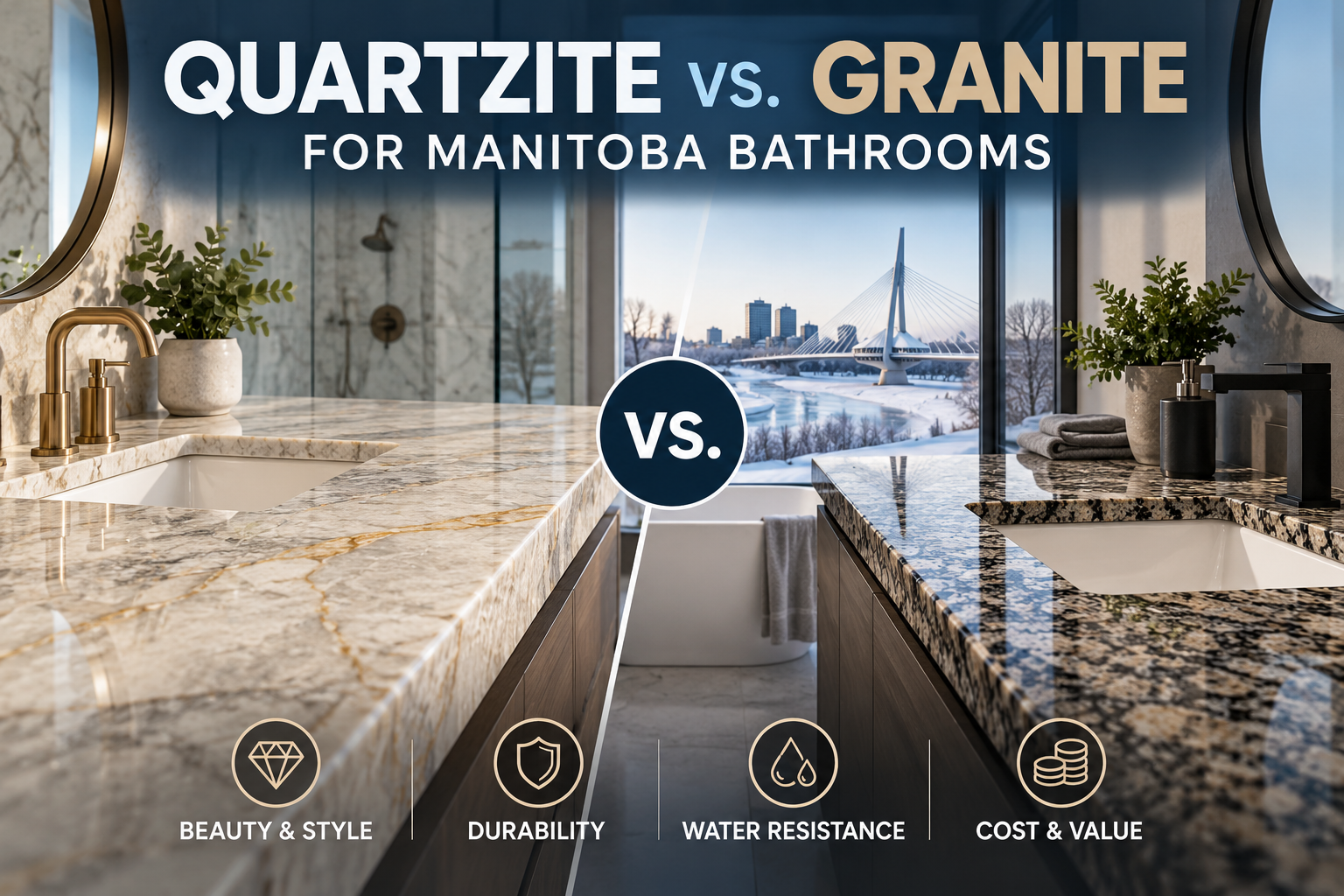
Both quartzite and granite are natural stone, both look exceptional in a bathroom, and both will outlast the cabinets around them. The question Manitoba homeowners actually need answered is more specific: which one holds up better in a room defined by daily moisture, temperature swings, and the occasional hair straightener left on the vanity?
This guide covers the real performance differences between quartzite and granite in a bathroom context, with honest notes on sealing, cost, heat tolerance, and the one factor most comparison articles skip entirely: what Manitoba’s climate actually does to natural stone over time.
The short answer: Granite is the reliable workhorse with a proven track record in Manitoba bathrooms. Quartzite is the upgrade pick for homeowners who want a marble-like look without marble’s fragility. Both require sealing. Neither is wrong. The decision comes down to your maintenance habits, your design goals, and your budget.
Key Takeaways
-
Both are natural stone and will outlast virtually any other vanity material, but they perform differently in a high-humidity bathroom environment.
-
Quartzite is harder (Mohs 7–8 vs. granite’s 6–7), more chemical-resistant, and typically needs sealing every 2–3 years rather than annually.
-
Granite costs less and is more widely stocked, which matters if you have a firm renovation timeline.
-
Manitoba’s climate (dry winters, humid summers) makes consistent sealing non-negotiable for either stone, more so than in temperate climates.
-
Neither etches the way marble does, so both handle bathroom products well when properly sealed.
-
If you want zero sealing, engineered quartz is the honest alternative; Granite Dynasty carries Cambria, HanStone, and LX.
-
For most Manitoba bathrooms, granite is the practical default. For a primary ensuite where the vanity is a design statement, quartzite earns its premium.
What Each Stone Actually Is
Before comparing performance, it helps to be clear on what you’re actually choosing between, because the naming in this category is genuinely confusing.
Granite
Granite is an igneous rock formed when magma cools slowly deep underground. It’s composed primarily of quartz, feldspar, and mica, which gives it that distinctive speckled appearance with flecks of colour throughout. Every slab is unique, but granite tends toward bold, busy patterns rather than the flowing veins you see in marble or quartzite.
Hardness: Approximately 6 to 7 on the Mohs scale. Resistant to everyday scratching from rings, keys, and grooming tools.
Quartzite
Quartzite is a metamorphic rock formed when sandstone is subjected to extreme heat and pressure underground. It’s composed almost entirely of quartz crystals, which makes it harder than granite, typically rating 7 to 8 on the Mohs scale. The visual result is often dramatic: flowing veins, pale backgrounds, and a look that reads as marble but performs far better.
Important distinction: Quartzite is not engineered quartz. Engineered quartz (like Cambria or HanStone) is a manufactured product made from crushed quartz and resin. Quartzite is a natural stone, quarried in slabs just like granite. The names cause constant confusion at the showroom level, and it matters because they perform differently.
| Quartzite | Granite | |
|---|---|---|
| Type | Natural metamorphic stone | Natural igneous stone |
| Hardness (Mohs) | 7–8 | 6–7 |
| Typical look | Flowing veins, marble-like | Speckled, bold patterns |
| Porosity | Moderate | Moderate to high |
| Sealing required | Yes, every 1–3 years | Yes, every 1–2 years |
| Etch resistant | Yes | Yes |
How They Perform in a Bathroom
A bathroom is a different environment than a kitchen. The heat exposure is lower (no open burners, no cast iron pans), but the moisture exposure is constant and the personal care products sitting on the vanity, think hairspray, perfume, nail polish remover, and acidic toners, are harder on stone than most cooking spills.
Moisture and Sealing
Both granite and quartzite are porous, which means they will absorb water and staining agents if left unsealed. This is the most important maintenance fact for a bathroom vanity, where water pools near the faucet every single day.
-
Granite typically needs resealing every 12 to 24 months, depending on the specific stone’s porosity and finish. According to the Natural Stone Institute, some granite slabs benefit from an impregnating sealer while others are dense enough to require minimal treatment. The right answer depends on the slab, not a blanket schedule.
-
Quartzite is generally less porous than granite and many slabs only need resealing every 2 to 3 years. Because it doesn’t etch the way marble does, quartzite handles acidic bathroom products better than most homeowners expect.
The practical difference: Both need sealing. Quartzite usually needs it less often. Neither will punish you if you stay on a reasonable schedule.
Heat Tolerance
Bathrooms involve heat in a specific way: styling tools. A flat iron or curling iron can reach 200°C or higher, and many people set them directly on the vanity without thinking.
Both granite and quartzite handle this better than engineered quartz, which contains resin that can scorch or discolour under direct heat. Natural stone won’t scorch, but repeated thermal shock in the same spot can stress the surface over years. A simple silicone mat or trivet near the mirror eliminates the risk entirely for either material.
Scratch Resistance
At 7 to 8 on the Mohs scale, quartzite is harder than granite and slightly more scratch-resistant. In a bathroom context, this difference is mostly academic. Neither material will scratch from everyday grooming products, jewellery, or cleaning tools. You would need a diamond or hardened steel to mark either surface under normal use.
Chemical Resistance
This is where quartzite earns its premium. Granite does not etch, but some granites are more reactive to strongly acidic or alkaline cleaners than quartzite. Quartzite’s near-pure quartz composition makes it highly resistant to the full range of personal care products that accumulate on a vanity. If your bathroom routine involves a lot of chemical products, quartzite is the more forgiving surface.
The Manitoba Factor: What Your Climate Does to Natural Stone
Most countertop comparison guides are written for a generic North American audience. Manitoba’s climate adds a layer of context that matters, particularly for homeowners in older homes or those doing bathroom additions with less controlled humidity environments.
Temperature and Humidity Swings
Manitoba winters are cold and dry. Manitoba summers are warm and humid. That swing, from -30°C and bone-dry in January to warm and humid in July, means any material in a bathroom is cycling through significant moisture changes year-round.
For natural stone vanity tops, this matters less than it does for exterior stone, where freeze-thaw cycles can crack an improperly sealed surface. But it does reinforce why consistent sealing is non-negotiable in this climate. A vanity sealed in spring and again in fall is protected. One that goes years without attention in a high-humidity Manitoba bathroom will eventually show staining around the sink.
The practical takeaway: Both granite and quartzite perform well in Manitoba bathrooms. The climate argument is not a reason to choose one over the other; it’s a reason to take the sealing schedule seriously regardless of which stone you choose.
Sourcing and Lead Times
Because quartzite is sourced slab by slab rather than stocked in standard colours, lead times for quartzite in Manitoba can be longer than for granite, particularly for premium or rare slabs. Granite is more widely available in stock, which can matter if your renovation has a firm timeline.
If you’re working toward a specific completion date, confirm slab availability before committing to a material. Granite Dynasty sources natural stone slab by slab rather than stocking it, so you choose the exact slab before anything is cut. Start at the Winnipeg showroom to compare samples and get a realistic timeline before anything is ordered.
Cost Comparison: Quartzite vs. Granite for a Manitoba Bathroom
Bathroom vanity tops are smaller than kitchen countertops, so the per-square-foot price difference between granite and quartzite has less impact on the total project cost than most homeowners expect. That said, quartzite consistently runs higher, and the gap is worth understanding before you fall in love with a slab.
What to Budget
According to Home Depot Canada’s countertop installation guide, natural stone countertops (granite, marble, and quartzite combined) run approximately $51 to $114 per square foot installed in Canada, with the average job coming in around $85 per square foot for a standard 28-square-foot countertop.
For a bathroom vanity, which typically runs 10 to 20 square feet, the real-world cost range looks roughly like this:
| Granite | Quartzite | |
|---|---|---|
| Material cost (per sq ft) | $50–$100 | $80–$150+ |
| Installed cost (per sq ft) | $75–$130 | $100–$175+ |
| Typical bathroom vanity total | $750–$2,600 | $1,000–$3,500+ |
| Sealing frequency | Every 1–2 years | Every 2–3 years |
These are general ranges. The actual price for your project depends on the specific slab, the complexity of the cut (undermount sink cutouts, edge profiles, backsplash returns), and your location within Manitoba. For a firm number, the best step is to request a quote with your measurements.
Where the Premium Goes
Quartzite costs more because it’s rarer and harder to fabricate. At 7 to 8 on the Mohs scale, it takes longer to cut and polish than granite. Premium slabs with dramatic veining also come from a smaller pool of quarries, so supply is tighter. If you’re choosing quartzite for its visual impact, the premium is justified. If your preferred granite slab achieves the same result, the savings are real.
One thing that doesn’t change: Granite Dynasty fabricates both materials in-house at its Springfield facility, which means you’re not paying a markup for outsourced cutting regardless of which stone you choose.
Which One Should You Choose?
There’s no universally correct answer, but there are clear patterns based on what matters most to you.
Choose Granite If:
-
You want proven performance at a lower price point
-
Your bathroom sees heavy daily use and you want a forgiving, well-understood material
-
You’re matching an existing granite surface elsewhere in the home
-
Your renovation timeline is tight and you need slab availability now
-
You prefer bold, speckled patterns over flowing veins
Choose Quartzite If:
-
You want the look of marble without marble’s fragility and acid sensitivity
-
You’re renovating a primary ensuite where the vanity is a design focal point
-
You’re comfortable with the higher material cost and slightly longer sourcing lead time
-
You want the hardest natural stone option available for a bathroom
-
A dramatic, veined slab is the centrepiece of the room
The One Scenario Where Neither Is the Right Call
If low maintenance is your absolute top priority and you don’t want to think about sealing at all, engineered quartz is the honest recommendation. It’s non-porous, never needs sealing, and handles the full range of bathroom products without complaint. Granite Dynasty carries Cambria, HanStone, and LX quartz if that’s the direction that fits your situation better.
Natural stone is the right choice when the look and feel of a real, one-of-a-kind slab matters to you. Both granite and quartzite deliver that. The choice between them is mostly a question of which look you prefer and how much you want to invest.
For more detail on the full range of natural stone countertop options available in Manitoba, including marble and soapstone, the natural stone overview covers each material’s strengths and where each one is the wrong answer.
Frequently Asked Questions
Is quartzite better than granite for a bathroom vanity?
Quartzite is harder, slightly more chemical-resistant, and typically needs sealing less often than granite. For a primary ensuite where design impact matters, it’s a strong choice. For a family bathroom where durability and budget are the priority, granite performs just as well at a lower cost. Neither is definitively better; the right answer depends on your specific priorities.
How often does natural stone need to be sealed in a Manitoba bathroom?
Granite typically needs resealing every 12 to 24 months. Quartzite usually runs every 2 to 3 years, depending on the specific slab’s porosity. Manitoba’s humidity swings between seasons make staying on schedule more important than in more temperate climates. A simple water test (drop a few tablespoons on the surface and watch whether it beads or absorbs) tells you when it’s time. For detailed guidance, see the countertop care and maintenance guide.
Can I use quartzite or granite for a tub surround, not just the vanity?
Yes, both materials work for tub surrounds and shower walls, though the installation is more complex than a vanity top. Seam placement, veining direction, and waterproofing behind the stone all need to be resolved before fabrication begins. If you’re considering natural stone for a wet-area surround, discuss it during the templating stage so the fabricator can plan the layout properly.
What’s the difference between quartzite and quartz?
Quartzite is a natural stone, quarried from the earth in slabs. Engineered quartz is a manufactured product made from ground quartz mineral bound with polymer resin. Quartzite has natural veining and variation; engineered quartz has a consistent, factory-made pattern. Quartzite needs sealing; engineered quartz does not. Both are durable bathroom options, but they are fundamentally different products.
How long does installation take for a bathroom vanity top in Winnipeg?
For installs within 150 km of Winnipeg, Granite Dynasty targets about five business days from template to installation. Projects further out are still welcome, but the timeline is set case by case. Templating happens after your cabinets are set and plumbing rough-in is complete. Installation itself is typically done in a few hours. The countertop installation page covers what to expect at each stage.
Does quartzite cost significantly more than granite for a bathroom?
For a typical bathroom vanity of 10 to 20 square feet, quartzite usually adds $250 to $800 to the total project cost compared to a mid-range granite. The gap narrows if you’re comparing a premium granite slab to an entry-level quartzite. The best way to compare accurately is to look at specific slabs side by side at the showroom, then price them against each other for your actual dimensions.
See the Slabs in Person
Reading about quartzite and granite only gets you so far. The veining, colour depth, and scale of a slab look completely different on a screen than they do in person, and a bathroom vanity is a small enough surface that the specific slab you choose matters more than the material category.
Granite Dynasty has showrooms in Winnipeg, Brandon, and Winkler. Bring your cabinet door or tile sample, compare quartzite and granite options, and get a realistic timeline and price range before committing to anything. Because natural stone is chosen slab by slab, the team will help you select and reserve the exact slab for your vanity.
If you already have your measurements, request a quote online and the team will come back with a real number rather than a placeholder range.